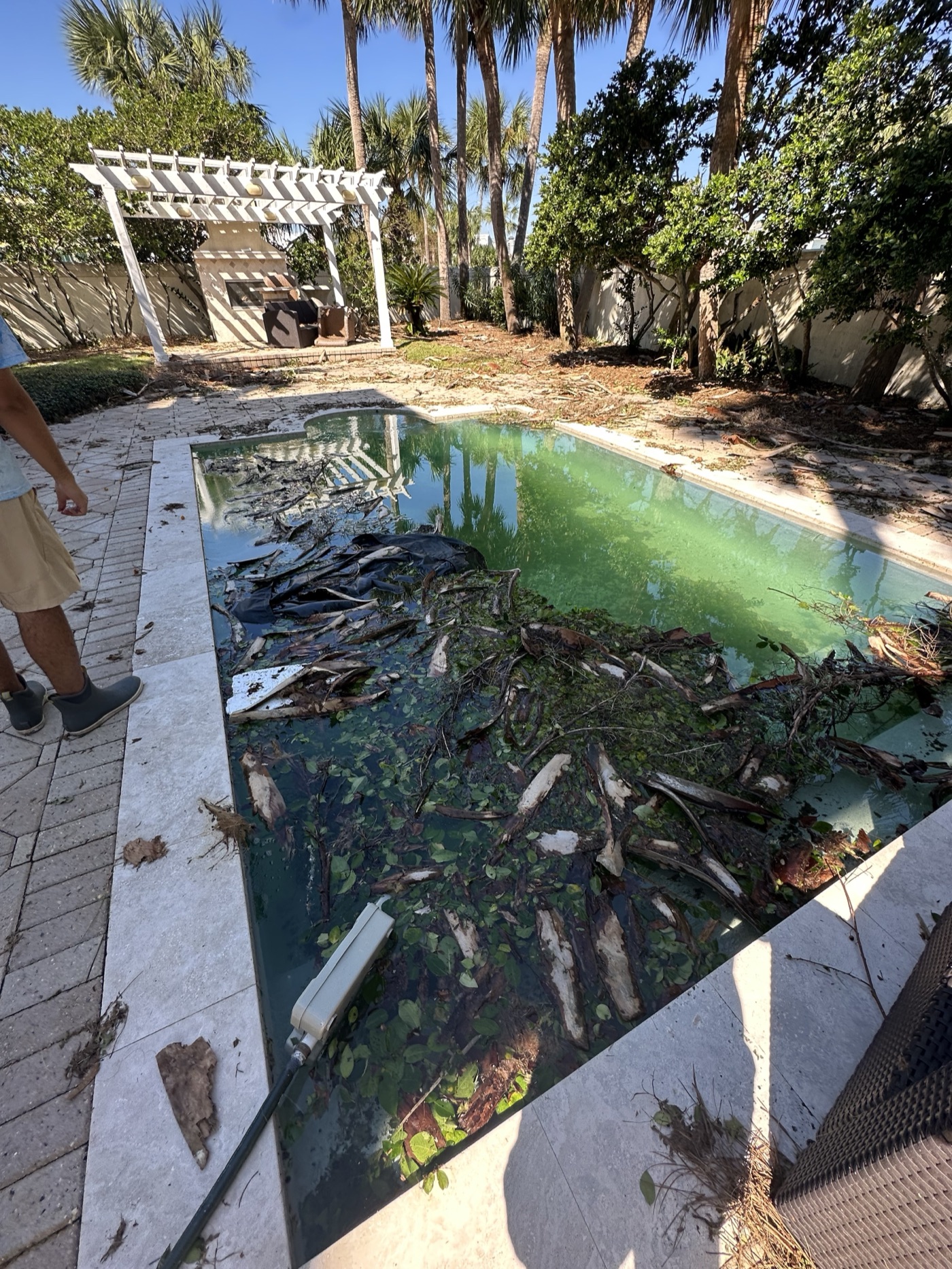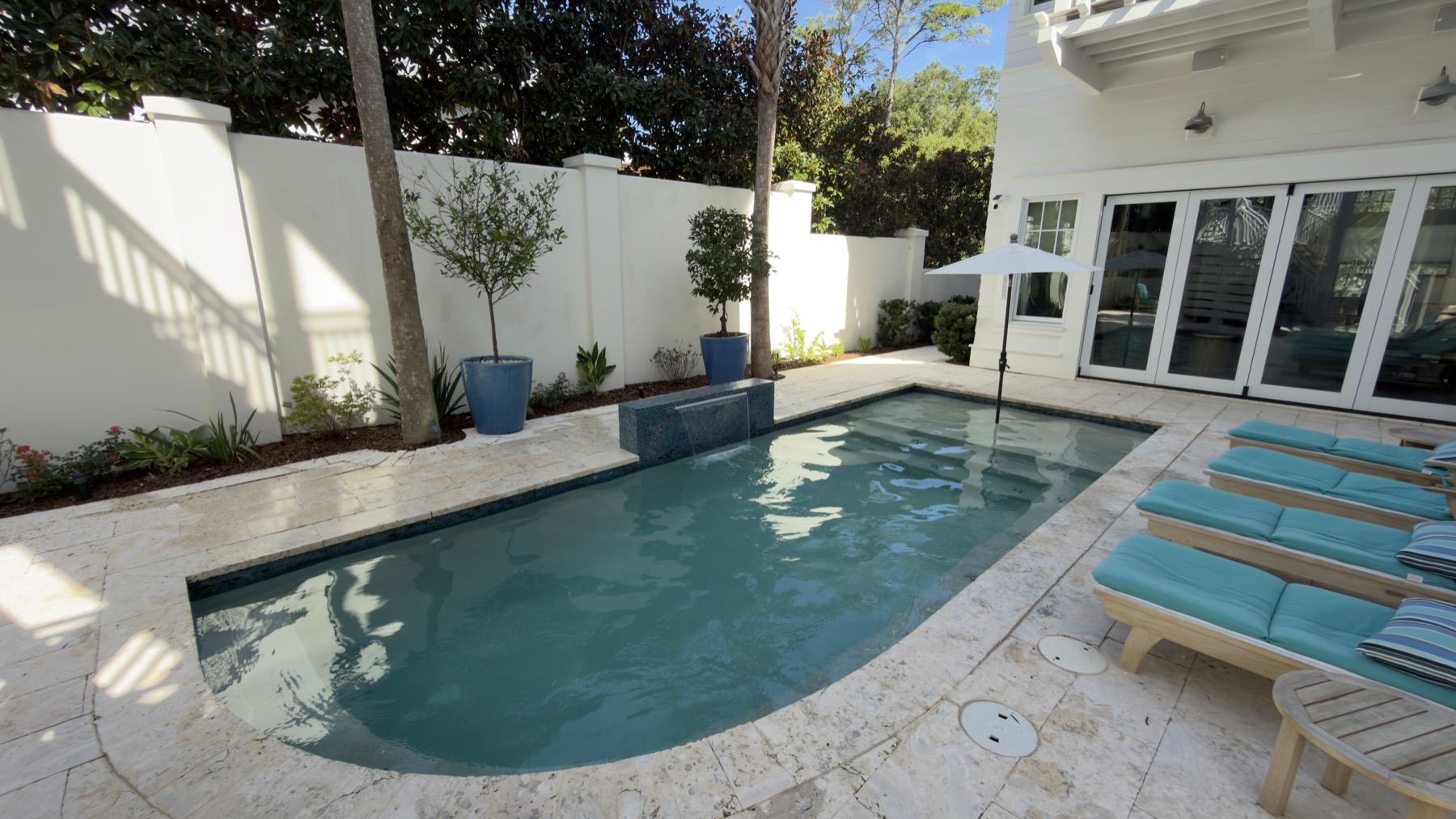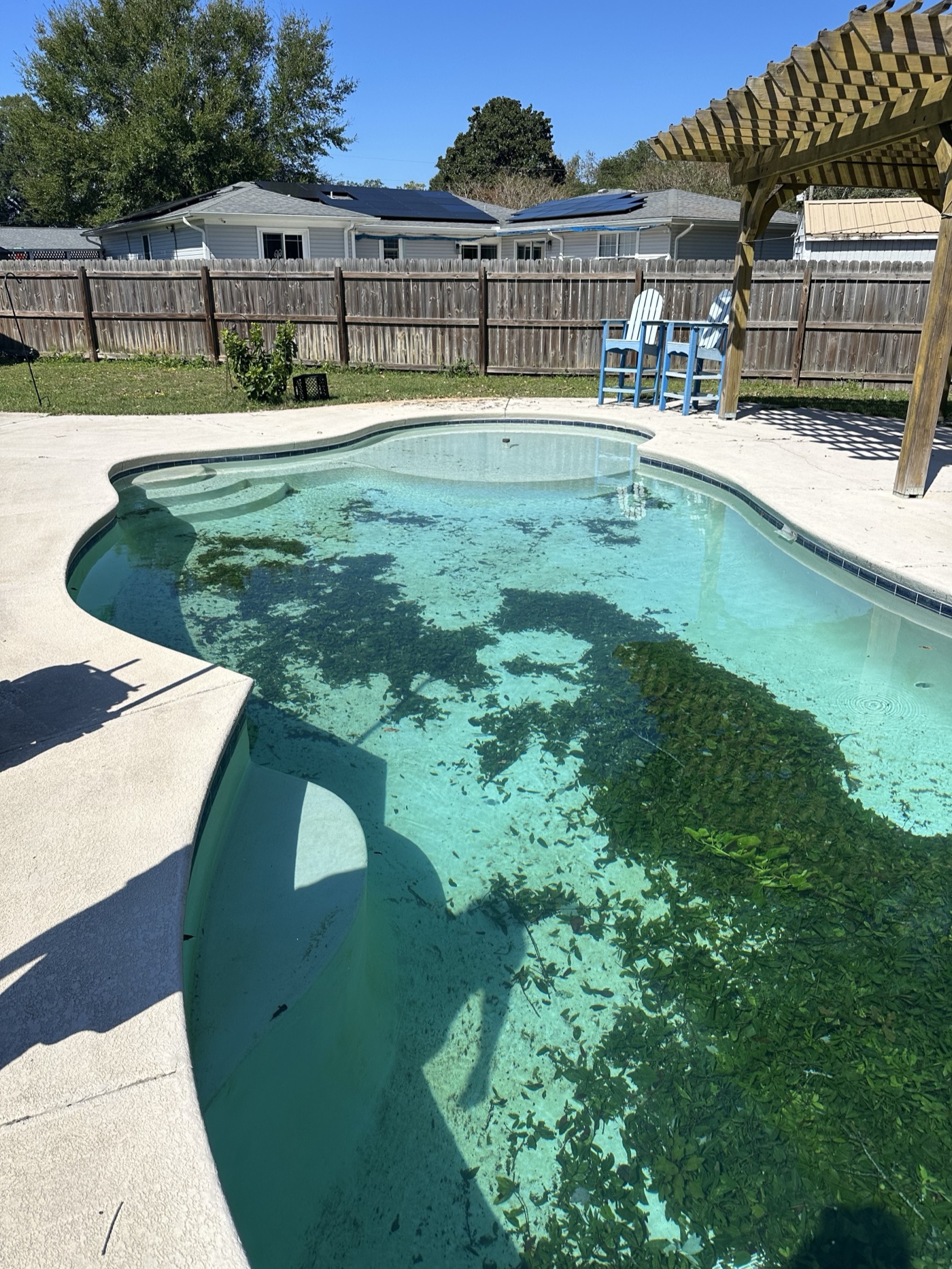
There is a difference between a pool that clouded over after a storm and a pool that nobody has touched since the spring. The first is a chemistry correction. The second is a recovery job, and it needs to be approached in a specific order or you will spend a lot of money on chemicals that accomplish very little.
In the trade this work is called green to clean. Here is what it actually involves.
How Pools Get There
Rarely through neglect in the way people assume. The usual causes are mundane: a pump failed and the repair got postponed. A rental sat vacant between the end of one season and the start of the next. A house changed hands and nobody was servicing it during the closing. An owner went up north for three months and the service was cancelled to save money. Or a storm knocked the power out, the pump stopped, and nobody got back out for a week.
Whatever the cause, the result is the same. Chlorine hits zero, circulation stops, debris accumulates, and in warm Florida water algae establishes itself fast.
Step One: Find Out What You Are Dealing With
Before a single chemical goes in, the water gets tested and the equipment gets checked. This step gets skipped constantly and it is the one that determines whether the rest of the work is even possible.
The number that decides everything is cyanuric acid. If stabilizer has climbed far past about 100 ppm, which happens in pools that ran on stabilized tablets for years, chlorine is so chemically bound that it cannot do the job at any dose. You can empty an entire case of shock into that pool and watch nothing happen. Water in that condition has to be partially diluted before anything else is worth attempting.
The equipment check matters just as much. If the pump is weak, the filter is packed solid or there is an air leak in the suction line, the pool cannot be recovered no matter how good the chemistry is, because dead algae has nowhere to go. Recovery is as much a filtration job as a chemical one.
Step Two: Get the Debris Out
This is the unglamorous part and it is most of the physical labor. Months of leaves, pine needles, palm fronds and silt have to come out before chemicals go in. Every bit of organic material still in that water will consume chlorine that was meant for the algae.
On a badly neglected pool this is done with a heavy leaf rake rather than a standard net, often blind, because the bottom is not visible. On the worst of them it comes out by hand. It is also the stage where you find out what else went in the pool while nobody was watching, which on the coast is frequently a surprising amount of furniture.
Skimmer and pump baskets get emptied, and on a pool this far gone they will need emptying repeatedly over the following days.
Step Three: Make the Equipment Work
The filter gets cleaned completely before the recovery starts, not after. Cartridges come out and get washed, DE grids get stripped and recharged. If the filter media is at the end of its life, it gets replaced now, because it is about to do more work in one week than it normally does in a year.
If the pump is the reason the pool went green in the first place, it gets repaired before anything else happens. There is no point shocking a pool that cannot circulate.
Step Four: Balance, Then Shock
pH comes into range first, somewhere around 7.2, because chlorine loses a large share of its effectiveness as pH rises. Shocking a pool sitting at 8.0 throws most of the chemical away.
Then the pool gets a real shock dose, sized to the volume and to how far gone it is, and applied at dusk so sunlight does not destroy it before it works. Under-shocking is the single most common failure in a DIY recovery: it kills some of the algae, the water turns a dull grey-green, and then it stalls. Half-killed algae recovers faster than you do.
On a badly neglected pool this is not one treatment. It is repeated over several days, with the level held up rather than allowed to crash back to zero overnight.
Step Five: Filter, Brush, Repeat
The pump runs twenty-four hours a day for the duration. Not eight. The filter gets cleaned every time the pressure climbs, which on a heavy recovery can mean daily, sometimes more than once a day as dead algae loads it up.
The walls, steps, waterline and corners get brushed daily. Algae anchors to surfaces and forms a protective film, and brushing is what breaks that open so the chlorine can reach it. The shaded corners and the area behind the ladder are where it hides.
Green turning to cloudy grey or milky white is the milestone you want. It means the algae is dead and suspended, and the remaining work belongs to the filter.
What Makes It Take Longer
Black algae is the hardest. It roots into plaster and builds a waxy protective layer, so it has to be physically scrubbed open before chemicals can touch it, and it regrows from anything left behind. Pools with persistent black algae sometimes need resurfacing to resolve permanently.
Mustard algae is chlorine-resistant and clings to shaded walls, and it tends to come straight back unless everything that touched the pool is treated too, including nets, brushes, floats and swimsuits.
High phosphates, common where a fertilized lawn drains toward the pool, keep feeding regrowth while you are trying to clear it.
Undersized or failing equipment extends everything, because filtration is the bottleneck once the algae is dead.
When Draining Is Actually the Right Call
It is a last resort, not a shortcut, and it is genuinely risky here. Our water table is high, and an empty shell can float, crack or shift out of the ground. That turns a water problem into a structural one that costs many times more.
Draining is justified when stabilizer is too high to correct any other way, when dissolved solids have built up to the point that nothing holds, when the plaster underneath needs repair regardless, or when the pool has been standing so long it has become a genuine health issue. Even then it should be done by someone who checks the water table conditions first and does it properly.
The Honest Economics
A green to clean costs meaningfully more than routine service, because it is days of labor, a large volume of chemicals and repeated filter work. It is almost always cheaper than the alternatives people consider instead, and it is always far more expensive than the weekly service that would have prevented it.
The part worth saying plainly: recovering the pool is only half the job. A pool that goes green once and then goes back to the same arrangement that let it happen will do it again. The recovery is worth doing when it is followed by a schedule.
If You Are Staring at One Right Now
Do not start pouring chemicals in. Get the debris out, find out what the water actually reads, and make sure the equipment runs. If it is beyond where you want to go, that is what we do. WittCo Pools handles green to clean recoveries across Destin, Miramar Beach, Santa Rosa Beach, Sandestin, Fort Walton Beach, Navarre and Crestview, and we will tell you honestly what it will take before we start. Call (850) 660-3394 or request a free quote.